Doctors Have a Name for What Happens After a Fall. Most Families Have Never Heard It.
The fall itself is only part of the danger. If your mom or dad lives alone, gets up at night or leaves their phone in another room, here's what you need to know before winter.
Updated October 2026 · Facts from the CDC, the BMJ and peer-reviewed research

When your mom or dad lives alone, there's a moment you've probably never let yourself picture.
It's 2:14 a.m. Your mom gets up for a glass of water, the way she has a thousand times before. Her slipper catches the edge of the rug. A second later, she's on the floor.
She isn't badly hurt. But she can't get back up.
Her phone is charging on the nightstand. Three feet away. It might as well be across town.
She calls out, but there's no one to hear. So she waits. For the morning. For a neighbor. For your call, the one she won't be able to answer.
Doctors have a name for this. They call it a "long lie." And it happens far more often than most families realize.
The part of a fall nobody plans for
A long lie means being unable to get up after a fall and staying on the floor for an hour or more. It has little to do with how hard someone falls, and everything to do with whether they can reach help.
When researchers from the University of Cambridge followed a group of people over 90 for a full year, the results were sobering:
The study found that long lies were strongly linked to serious injuries, hospital admissions and moves into long-term care. Being stuck on the floor is also associated with dehydration and pressure injuries.
The good news? The fix is far simpler than most families expect, and it doesn't come with a monthly bill. We'll get to it in a moment. First, it helps to understand why this happens to so many independent parents.
It isn't just "frail" people. It's millions of independent parents.
It's easy to think this happens to someone else's parents. The numbers say otherwise.
According to the CDC, about 1 in 4 adults over 65 report a fall every year, more than 14 million people. Falls are the leading cause of injury in that age group, and the older-adult fall death rate has risen by 21% since 2018.
And most falls don't happen on icy sidewalks. In one study of U.S. emergency room records, 79% of falls that led to an ER visit happened at home, most often in the bedroom, the bathroom and on the stairs.
In other words: the places our parents feel safest.
"But she has her phone."
Almost every family says it. And almost every family is picturing the phone in her hand.
In reality, it's charging in the kitchen. Or sitting on the nightstand. Or in a coat pocket by the door. Nobody takes a phone into the shower, and nobody carries one on a 2 a.m. trip to the bathroom.

The other plans don't hold up much better. The neighbors are kind, but they aren't there at night. And your parent? In one survey, 97% of seniors rated their own homes as safe. Which is exactly why so few have a plan for the moment it isn't.
"Why not just get a medical alert system?"
It's the obvious answer, and for years it was the only one. But most families who look into them run into the same three problems:
- The cost. Monitored plans typically run $25 to $90 a month, often with contracts and setup fees. That's hundreds of dollars a year, every year.
- The look. Many are bulky pendants that look like hospital equipment. Plenty of independent parents simply refuse to wear them.
- They often go unused. In that same Cambridge study, most people who had a call alarm didn't use it when they fell and couldn't get up. Some felt it wasn't for them. Others worried about looking dependent.
So families end up with an expensive device sitting in a drawer, and the same worry they started with.
A simpler idea: put help on their wrist
That's the gap the Everlo™ SOS Alert Bracelet was designed to close. Instead of another complicated system, it does one thing, the moment it matters.
It's a lightweight, watch-style bracelet with a single large red button. When they press it, an instant alert goes straight to your phone, and to anyone else in the family you've added. No screen. No menus. Nothing to learn.
We call it One-Press Family Alert, and it works in three simple steps:
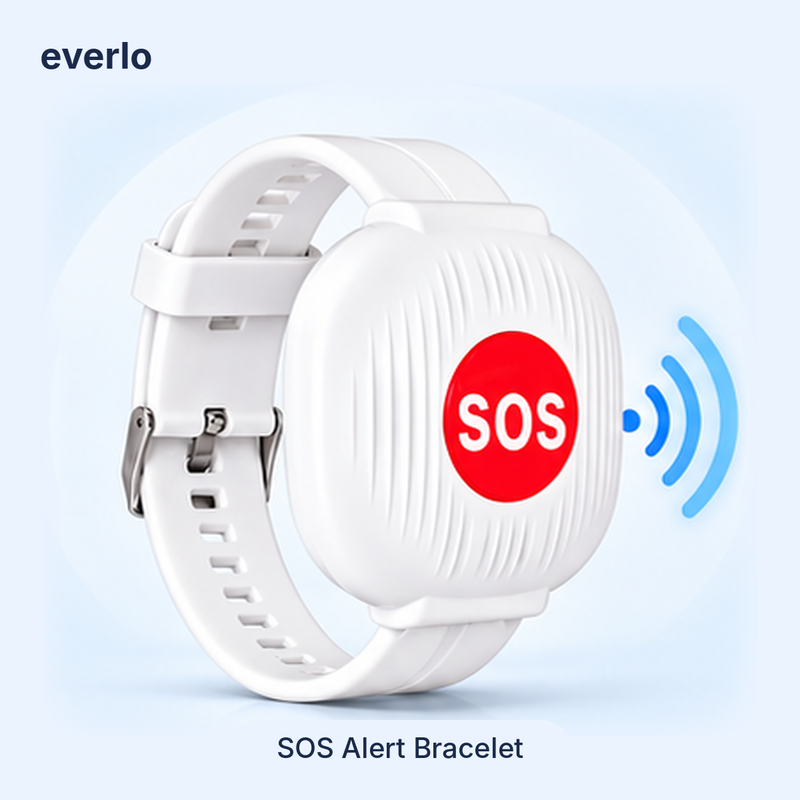
- 1They press SOSOne big button they can find without looking.
- 2Your phone alerts you instantlyEveryone you've added in the family gets the alert at once.
- 3You respondCall them, go round or send help. You're never the last to know.
Think back to 2:14 a.m. With Everlo™ on her wrist, the story ends differently. She presses the button. Your phone lights up. Two minutes later, you're on the phone with her, or someone is on the way. She's no longer waiting alone.
Designed so they'll actually wear it
We took the biggest lesson from traditional alarms seriously: a safety device only works if it's on them. So Everlo™ looks like a clean, modern watch, not a medical device. It's light, soft on the skin and easy to forget it's there.

And it's about more than emergencies. In a study of more than 4,000 adults over 70, over half said they were afraid of falling, and more than a third had started avoiding everyday activities because of it. Gardening. Walks. Cooking a proper dinner.
Knowing help is one press away can give them the confidence to keep living on their own terms.
And it gives you something back, too
If you've ever called your mom, heard it ring out, and felt your stomach drop, you're not alone. In one recent survey, 86% of adult children said they worry about their aging parents, far more than the parents worry about themselves.
Everlo™ doesn't replace calling or visiting. But it means that if something happens, you'll be the first to know, not the last. No more lying awake wondering. No more "why isn't she picking up?"

Is Everlo™ right for your family? An honest answer
We'd rather you buy the right thing than the wrong thing from us. So here's the honest version.
A great fit if…
- They live alone, or are often home alone
- They're independent and won't wear anything "medical"
- You want to know instantly, without a monthly bill
- They can press a button when they need help
Not the right fit if…
- You want a 24/7 professional call center. Choose a monitored plan.
- They may not be able to press a button, for example due to memory problems. Look for automatic fall detection.
Give them help in one press
The more family you protect, the more you save. Free gifts included.

What families ask before buying
Does it call 911?
No. It sends an instant alert to the family members you choose, not a call center. That's how there are no monthly fees. In a serious emergency, always call 911.
How does setup work?
Charge the bracelet, download the free app, pair it with your phone and add your family. Most families are set up in a few minutes, and your parent never has to touch a phone.
Will the alert reach me at night?
Yes, as long as the app's notifications are turned on and allowed through Do Not Disturb or Focus mode on your phone. Press the button once as a test, so everyone knows exactly what the alert looks like.
When will it arrive?
Most orders arrive in about 2 weeks, with tracking sent by email. Buying for Christmas? Order by December 10.
What if it's not right for us?
You have 30 days to try it. If it isn't right for your family, send it back for a full refund. It's also covered by a 1-year warranty.
P.S. The worst time to look for a plan is the morning after a fall. If your mom or dad lives alone, gets up at night or doesn't keep their phone on them, a simple plan today could make all the difference on the night it matters. And with a 30-day money-back guarantee, you have nothing to lose by trying it.
Yes, I Want Peace of MindEverlo™ SOS Alert Bracelet
- One press alerts your phone instantly
- Alerts the whole family at once
- Looks like a modern watch
- No monthly fees, ever
- Free gifts with 2+ bracelets